I'm very pleased to host Leila Johnston, our most recent recruit and a fabulous content strategist, talking here about Google+. Leila's awaiting her Made by Many avatar before she can post directly, so stay tuned to hear more from Leila soon.

Over to Leila...
I prefer Google+ to Facebook, but then I was never a fan. Google+ might be functional, but Facebook treats human beings with the ramshackle ambivalence of Howl's Moving Castle. You get inside the walls, you tell it your secrets, it shares them with everyone in earshot. You learn its spells, its doors open onto faces and places from your past, someone tags an embarrassing photo of you, it changes its privacy settings. We're so used to Facebook that we've forgotten how esoteric and demanding it is. What's the difference between groups, pages, profiles, walls? If I type this here, in this box, which subset of contacts will be notified about it? These aren't questions that Facebook expects to have to answer, and having turned up to the F-club party a good five years later than everyone else, I found the Special Knowledge had already been imprinted on the brains of everyone I knew. I was surrounded by Facebook Midwich Cuckoos. They talked about Facebook, they socialised on it and through it, they won and lost games, love and jobs on it. But I could barely manage to type the text in the right box. I would flail around inside looking for things, pounding buttons where it felt like I'd pounded buttons before. I became a superstitious pigeon, spinning round and round in case that had been the thing that released the corn. And then one day, inevitably, I found myself banned without explanation. Thrown out of the castle, my access to photos of familiar drunks permanently revoked, alone and naked as the day I was born, I logged back into Twitter.
Now, clearly I find navigation quite difficult at the best of times, so am perhaps a bit disproportionately grateful for anything that doesn't require prior knowledge to figure out. Google+ starts by asking for your knowledge. While it divides information in various ways, the core configuration – 'what we normally see' – is up to us. And unlike the shady backwater of Twitter lists, it's easy to change our principal viewing stream between sectors we've created, using the famous circles. By contrast, Flickr still madly layers multiple organisational frameworks over the stream, spawning a million different Flickrs, while the destination of the 'your photos' button, in many ways the home, is infuriatingly out of our hands. And this is the point: I want the main viewing stream to feel like a home. If Facebook's a home it's one plastered with pictures of other people's babies. In the house of Twitter, we're kneeling in the hallway shouting through the letterbox. But partly because it's new, and partly thanks to the circles and the excellent Hangout, my Google+ quarters are quiet, and full of people I like.
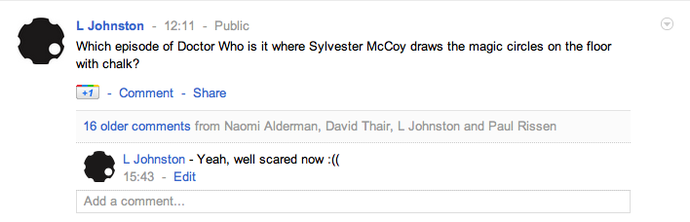
Google+ hasn't emerged from a vacuum; it knows about the brain-training we've received on previous platforms, and leverages the advantage of having ancestors. This '+1' business might just be a wordless 'Like', but it feels good to approve, and to be approved, and maybe it's time the measles-spread of that cursed 'Like' button was interrupted, anyway. What about Twitter, has it finally been toppled?
John Graham-Cumming thinks not, pointing out that its RSS-like feed doesn't pose the same enticing crafting challenge of the micro-blogging platform. I'd add that it also attempts to dodge some of the politics of Twitter, that follow-back/
retweet-me nonsense that quickly turns a list of quips from close-knit friends turns into an unintelligible tangle of stranger babble. While Twitter certainly is an exercise in old school concision, Google+ operates a different kind of editorial discrimination. Your experience is filtered by you: you check, you prune, and you decide what's worth seeing – you're the editor.
Duplication or not, we at Made by Many are hearing it out. Joining is so simple for those already in the Google family that it's easy for us to dive in first, ask questions about whether it works for us later. And particularly during these early days, the small, exclusive audiences (not to mention the overenthusiastic simultaneous multi-channel alerts) mean that you can exchange specialised ideas and materials very quickly indeed. Plenty of early adopters will be existing fans, supportive of the company's track record for innovation, but to thrive like the search engine it will need to feel a little magical and extremely timely. So maybe the question isn't "Do we need another social network?" so much as "Is the time right for us to become social curators? We don't need another Facebook, we didn't even need the first one, but Facebook was only as good as your friends. Google+ will be good as your content strategy.
